
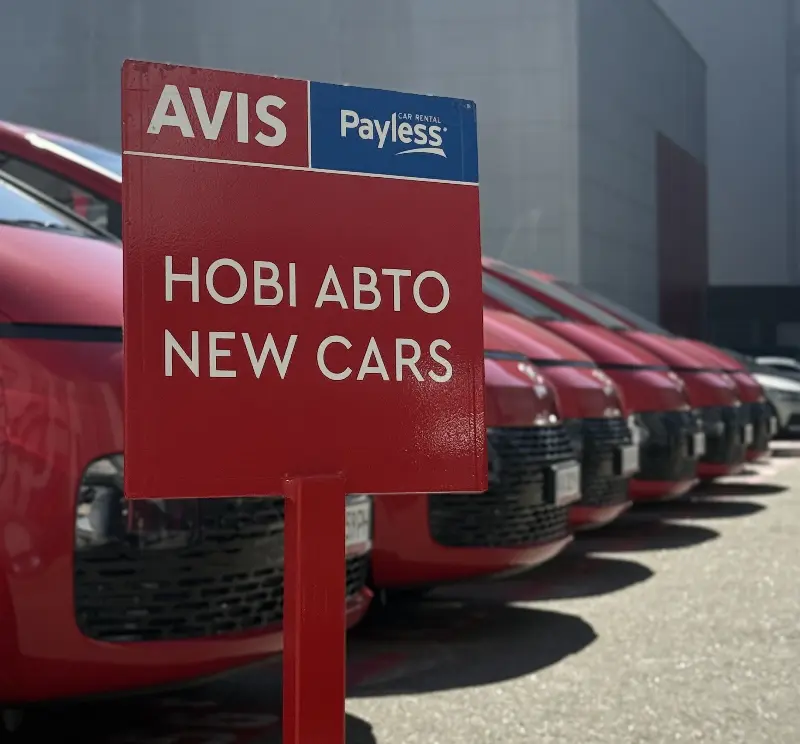
Our company, Avis Ukraine, has summarized the results of 2025 and reports a clear sign of market transformation. Over the course of the year, we provided 841 vehicles to corporate clients under operating leases.
Our company, Avis Ukraine, has summarized the results of 2025 and reports a clear signal of market transformation. During the year, we delivered 841 vehicles under operational leasing agreements to corporate clients. This figure reflects stable demand from businesses and the growing role of operational leasing as a tool for efficiency management.
The demand structure in 2025 clearly demonstrates a new business decision-making logic. The leading importers that supplied vehicles for Avis Ukraine clients were:
The focus is no longer on image, but on rationality: costs, reliability, and predictable vehicle operation.
The most popular models further confirm this trend: Skoda Octavia A8, Skoda Kodiaq, Toyota Yaris Cross Hybrid, Toyota Corolla, Renault Duster, Renault Taliant, Hyundai Elantra, and Citroen C-Elysee represent a balance of total cost of ownership, functionality, and versatility for business needs.
The key change lies in the mindset of decision-makers. Businesses are no longer buying a “monthly payment”; they are investing in operational continuity.
Service has become a critical factor: maintenance speed, availability of replacement vehicles, and minimizing downtime. A vehicle is no longer perceived as an asset acquired simply for formality—it has become an integral part of a company’s operating model.
“Today, a fleet is part of an operational strategy. Businesses are not choosing vehicles; they are choosing business continuity. And this is exactly what determines the choice of a leasing partner. Financial directors no longer view a vehicle as a one-time purchase. The focus is on TCO (Total Cost of Ownership): service, downtime, and team efficiency. A seemingly inexpensive solution based on the monthly payment often turns out to be more expensive throughout the operational lifecycle,” comments Anastasiia Myronenko, Head of Sales Department at Avis Ukraine.
According to our estimates, the market will continue its dynamic growth in 2026. In the second half of the year, growth of 10–20% is expected against the backdrop of the overall recovery of the automotive market.
The main change is structural:
Businesses are increasingly choosing a 4–5-year cycle with subsequent fleet renewal without capitalizing the asset on the balance sheet.
Demand is also transforming at the product level:
In this context, car leasing serves as a driver of the environmental transition due to the predictability of total cost of ownership (TCO) and the absence of resale risks.
The final emphasis is on the changing role of the vehicle itself.
“Today, our company serves both international and Ukrainian businesses, providing a full cycle of fleet management. Our key principle is simple: a vehicle must either generate revenue or save time that generates revenue. Otherwise, it is not a tool—it is an expense,” concludes Anastasiia Myronenko.


